What Are Russian Equity Markets?
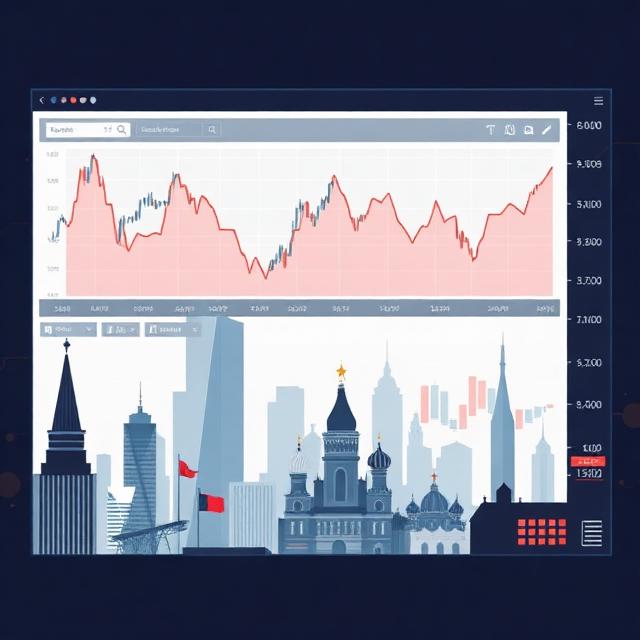
Russian equity markets refer to the organized stock exchanges and listed companies operating within the Russian Federation. These markets facilitate the trading of shares in publicly listed Russian firms and serve as a barometer of the country’s economic health, investor sentiment, and capital formation.
Historically, Russian equity markets have played a dual role:
- Capital allocation for major industrial sectors, particularly energy and mining
- A geopolitical risk proxy, often reacting sharply to global political events
Main Stock Exchanges in Russia
Moscow Exchange (MOEX)
The Moscow Exchange is Russia’s primary and virtually sole functioning stock exchange following the consolidation of Russian trading venues. It lists equities, bonds, derivatives, and currencies, with equities forming a central component.
Key characteristics:
- Ruble-denominated trading
- Heavy state and quasi-state corporate presence
- Dominance of domestic institutional and retail investors
RTS Stock Exchange (Index Legacy)
While the RTS Stock Exchange was merged into MOEX, the RTS Index remains a widely followed benchmark. Unlike MOEX, the RTS Index is U.S. dollar-denominated, making it particularly sensitive to currency fluctuations.
Key Russian Equity Indices
RTS Index
- Dollar-based index tracking major Russian blue-chip stocks
- Often used by international analysts for historical comparison
- Highly volatile during ruble devaluations
MOEX Russia Index
- Ruble-denominated benchmark
- More reflective of domestic investor conditions
- Less distorted by currency effects than the RTS
Together, these indices provide complementary perspectives on russian equity markets.
Sector Composition of Russian Equity Markets
Russian stock markets are heavily concentrated, unlike more diversified developed markets.
Dominant Sectors
- Energy (Oil & Gas): Gazprom, Rosneft, Lukoil
- Materials & Mining: Norilsk Nickel, Alrosa
- Financials: Sberbank, VTB
- Utilities & Transport: Russian Railways-linked entities, power generators
This concentration makes russian equity markets particularly sensitive to:
- Global commodity prices
- Energy demand cycles
- Export restrictions and sanctions
Historical Performance Overview
Since the mid-1990s, russian equity markets have experienced extreme boom-and-bust cycles:
- 1998: Market collapse during the Russian financial crisis
- 2000–2008: Strong growth driven by rising oil prices
- 2008: Sharp decline during the global financial crisis
- 2014: Volatility following Crimea-related sanctions
- 2020: Pandemic-related selloff
- 2022 onward: Structural market isolation due to geopolitical events
The RTS Index reached its all-time high in 2008 and has since struggled to reclaim those levels.
Impact of Sanctions on Russian Equity Markets
Sanctions have fundamentally reshaped russian equity markets.
Key Effects
- Suspension of many foreign listings and trading access
- Restrictions on foreign ownership and capital repatriation
- Reduced liquidity and price discovery
- Increased role of state support mechanisms
As a result, valuations in russian equity markets often trade at significant discounts compared to global peers, reflecting elevated political and legal risk premiums.
Foreign vs Domestic Investor Participation
Foreign Investors
- Limited access to trading since 2022
- Capital controls restrict exits
- Exposure largely frozen or written down by many institutions
Domestic Investors
- Increased participation from Russian retail traders
- Pension funds and state-linked institutions act as stabilizers
- Growing importance of ruble-based savings flows
This shift has transformed russian equity markets into a primarily domestic ecosystem.
Currency Risk and Equity Valuations
Currency movements play an outsized role in russian equity markets.
- A weaker ruble can boost exporter revenues in local terms
- Dollar-denominated indices may fall even when local prices rise
- Foreign investors face dual equity and FX risk
This dynamic explains why MOEX and RTS performance often diverge sharply.
Corporate Governance and Transparency
Corporate governance standards in russian equity markets vary widely.
Challenges include:
- State influence over strategic companies
- Limited shareholder protections
- Reduced disclosure following sanctions
However, some large companies maintain relatively high reporting standards, especially those with legacy international investor bases.
Risks of Investing in Russian Equity Markets
Russian equity markets carry non-standard investment risks, including:
- Geopolitical escalation
- Regulatory unpredictability
- Capital controls
- Trading suspensions
- Sanctions expansion
These risks are structural rather than cyclical, requiring a fundamentally different risk assessment than developed markets.
Potential Opportunities and Long-Term Outlook
Despite challenges, proponents argue that russian equity markets may offer:
- Deep value pricing
- High dividend yields in ruble terms
- Exposure to global commodity cycles
The long-term outlook depends heavily on:
- Geopolitical normalization
- Sanctions relief
- Reintegration with global financial systems
Until then, russian equity markets are likely to remain volatile, domestically driven, and discounted.
Conclusion
Russian equity markets are unique among global stock markets. They combine rich natural-resource exposure with high geopolitical risk, limited accessibility, and heavy state involvement. While historically capable of delivering strong returns during favorable cycles, current conditions place russian equity markets firmly in the high-risk category, suitable only for investors who fully understand their structural constraints.